
Molex is showcasing its high-speed data connectivity solutions at DesignCon 2018 in Santa Clara, Calif., this week. In its booth 633, the company will feature next-generation technologies designed to meet rising data speeds and bandwidth in demanding networking and high-performance computing applications.
“As more data is generated and infrastructure moves to the cloud, next-generation I/O and cabling solutions support faster processing, more bandwidth, increased density and thermal management—while maximizing data flow efficiency and reliability in today’s data centers,” said Jairo Guerrero, general manager of enterprise solutions, Molex.
At DesignCon 2018, Molex will display the following demos:
- Impulse Orthogonal Direct Backplane Connector System delivers improved performance, class-leading density and cost savings by eliminating the need to build and install midplane connections. Designed for high-density data center applications, the new Impulse backplane system supports data rates of 56 and 112 Gbps PAM-4 with superior signal integrity.
- The Quad Small Form Factor Pluggable Double Density (QSFP-DD) System for high-density, high-speed networking will showcase how the eight-lane electrical interface operates up to 25 Gbps NRZ modulation or 56 Gbps PAM-4, with feasibility of 112 Gbps PAM-4, in support of the growth in future bandwidth needs.
- Mirror Mezz Connectors highlight flexibility with stackable mating to support data speeds up to 56 Gbps NRZ and 112 Gbps PAM-4 per differential pair. These hermaphroditic connectors are highly compact and designed to provide ease in PCB routing in any direction out of the connector interface.
-
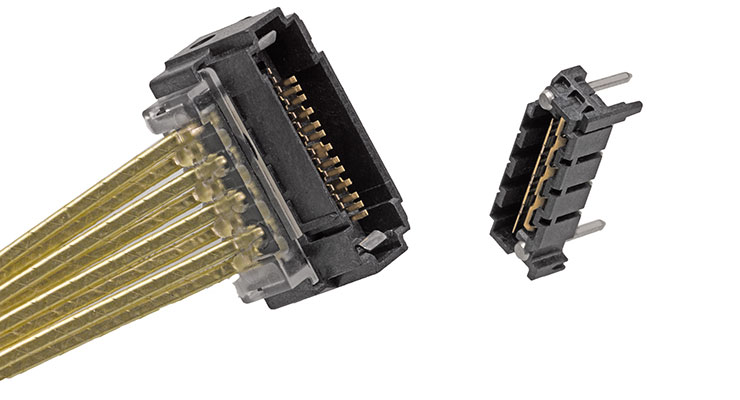
Molex’s NearStack high-speed connector system and cable jumper assemblies NearStack High-Speed Connector System and Cable Jumper Assemblies use twinax cables to deliver a PCB alternative with superior signal integrity and low insertion loss while enabling implementation of 56 Gbps NRZ and a path to 112 Gbps PAM-4.
- Impel Plus Cabling System showcases its backbone functionality within the Open19 Project which defines a common form factor for servers, Tier0 switches, and power shelves with a base internal cage system that can be implemented into a standard 19” rack solution. Delivering lower costs and reliable signal integrity from the switch to server with a robust connector to cable interface, the Molex Impel Plus Cabling System achieves data rates up to 50 Gbps PAM-4 to create 100 Gbps connectivity per server with the Open19 solution.
Molex will highlight its high-density blind-mating optical backplane connectors for card, sled and drawer applications that incorporate multi-fiber MT and VersaBeam expanded beam MT ferrule technology enabling the deployment of optical I/O based hardware. By utilizing Molex FlexPlane and Routed Ribbon Solutions, system architects are able to manage on board optical fiber counts that range from hundreds to thousands of fibers.
Combining passive, high-speed copper twinax cables with NearStack and QSFP+ or QSFP-DD connectors, BiPass I/O and Backplane Cable Assemblies provide a low-insertion-loss alternative to PCB traces for high bandwidth speeds, efficiency and proper thermal management. The integrated, one-piece BiPass cable assembly ensures easy installation in data switching, IP networking and telecom communications for 56 Gbps PAM-4 and a path to 112 Gbps PAM-4 applications.
Interconnect Systems International (ISI) will display their advanced packaging and interconnect solutions using a multi-discipline customized approach to improve solution performance, reduce package size and expedite time-to-market for customers.
The newly expanded zSFP+ Interconnect System that supports 56 Gbps PAM-4 channels in stacked 2xN port configurations, will showcase how next-generation Ethernet and Fibre Channel applications receive standout signal integrity. The system allows for users to merge standard cables and modules with the increased data-rate accepted.
Additionally, Molex will join other industry experts in two technical sessions at DesignCon 2018:
- 10-10:45 am, Wednesday, January 31: 112G Electrical System Performance Study — Based on an Improved Salz SNR Methodology. The technical session will explore an early system design stage for 112G when no silicon nor hardware components are available, an improved Salz SNR analytical model is derived and a methodology for assessing system margin is introduced. Unlike traditional ICR based Salz method, major noise terms that are recognized to be dominant and are weighted much higher in PAM-4 than in NRZ systems are included. Performance ‘upper limits’ such as maximal tolerable insertion loss and crosstalk for ‘optimal’ modulation scheme is analyzed for six backplane architectures and those with higher possibility to meet the ‘upper limits’ are selected for full channel modeling and margin analysis. Molex experts will discuss how channel architectures are using most up-to-date Molex Backplane family of connectors such as Impulse Orthogonal Direct connectors and Impulse backplane cables as well as BiPass cable assemblies with near-ASIC connector family to solve design challenges.
- 2:50-3:30pm, Wednesday, January 31: Fast Resonance Reduction Using Eigenmode Solution and Custom Metrics. The technical presentation will focus on the presence of resonant frequencies in electromechanical devices as one of the primary issues that inhibits the quality of high-speed data transmission. Signal integrity engineers typically spend a significant portion of the design process on finding and suppressing resonances; this is primarily due to the iterative nature and computational expense of using conventional frequency-domain solvers. Molex experts will discuss an alternative design approach and methods used to quickly identifying resonances in multi-ground connector and circuit board structures.

Leave a Reply
You must be logged in to post a comment.