
Contributed by Niklas Wittler, Global Product Manager Board to Board Solutions

Connector specialist Harting not only wants to cater to the megatrend of miniaturization, but also lead it with clever solutions. This most of all concerns miniaturized and flexible PCB connections. Especially as there is no place where miniaturization takes greater effect than inside the device. In this regard, the har-flex series has been standing for flexible and compact connection solutions for quite a while already. Now it is being equipped, in addition to the already adaptable concept, with two further important building blocks for wide-ranging possibilities in device development – har-flex Hybrid and Power for compact applications with power, and the har-flex HD card Edge in an 0.8 mm pitch for transferring high data rates.
The miniaturization of devices is also a steady process in industry. This means that components such as connectors need to shrink ever more. To not only keep up with this, but also be able to cover solutions for the requirements of tomorrow and the day after Harting has developed the har-flex connectors. The flexibility in the pin count from 6 – 100 and stacking height from 8 – 20 mm lets developers enjoy all freedoms in the development of their devices.
This factor is increasingly gaining in importance because every case is unique in the construction of industrial devices. Every housing needs to cater to different sizes, shapes and requirements. The PCBs inside devices are thus also constantly required to make up for other spatial conditions. Every board needs to be at a firmly defined position for interfaces with the housing wall or other electronic components. These vary depending on the device and use. To achieve the required miniaturization here, the har-flex interface makes for a particularly space-saving option with its 1.27 mm pitch.
Signal meets power
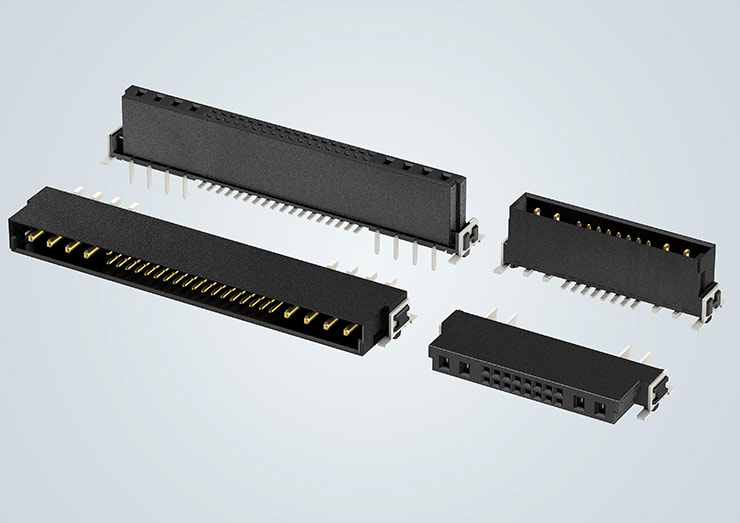
To enable the simultaneous transfer of signals and power from one PCB to the other, Harting is expanding the har-flex family by the new Hybrid variant. The claim to small, flexible, robust applies here as never before. har-flex Hybrid enables signal and power contacts to be combined in one insulator. A current carrying capacity of 18 A permits the desired power to be space-savingly transferred by way of few contacts. In the past, several signal contacts needed to be combined in this for power transmission, which was linked with greater space requirements, as well as the use of a separate connector just for the power supply. And the throughput times in production are also improved as the placement of an additional power connector can be avoided.
To prevent the power from inductively interfering with transferable data, adjoining pins can be earthed. Whoever has the room and still wants to transfer power in a small space can bank on the separate har-flex Power connector. This is of the same type as the already familiar har-flex Signal connectors and thus offers the ideal complement.
Besides the pin counts, users can choose between SMT fixing or with additional hold downs in the Hybrid or Power variant, depending on the application. The power pins are all available as THR or SMT contacts. While the SMT contacts will leave the back of the board virtually untouched, the THR contacts offer a better heat dissipation and higher stability. The new har-flex Hybrid & Power variants have been created in already familiar designs and thus offer solutions for mezzanines, motherboard-to-daughterboard and extender card connections.

har-flex HD Card Edge for high data rates
Advanced Ethernet for IIoT applications is also an important topic on the circuit board. With the introduction of the har-flex HD (= high density) card Edge, this is now advancing into even smaller ranges of board connectivity and bringing GBit Ethernet to the PCB from autumn 2020. The start is made with the har-flex HD card series Edge in a 0.8 mm pitch, which transfers up to 25 Gbit/s from board to board. The series is designed as a one-piece-connector with pin counts from 20 to 140 contacts, meaning that the mating contacts are directly integrated in the board layout and no further connector is required. For the stability required in industry, there is a solution with additional hold downs in SMT und THR. These boost the mechanical robustness in general, and particularly against transverse forces.
To cater to the increasingly automated production, all har-flex connectors are pick-and-place capable and contactable in the reflow soldering process. To also support users in their processing, Harting sets great store by absolute precision with its components.
To be mentioned in this context is coplanarity. This describes how parallel and evenly signal contacts and retaining pins are mutually oriented in a SMD connector, which is decisive for the later quality of the solder connection. If connecting pins deviate too much from one another, the connection can be of a bad to faulty quality. To ensure good solderability, the coplanarity of all contacts is thus continuously monitored in the production already. This guarantees the high quality and Harting’s own claim to reliable interfaces. Besides an optical monitoring in keeping with IPC-A-610 Class 3 standards, which is based on externally visible criteria such as the wetting angle and filling degree, the Harting labs also use metallographic specimens and radiotechnology to monitor the quality of soldered joints.
Also of relevance for a good connection besides the correct position of the contact pins is their coating. har-flex contacts are equipped with a tin coat that forms a reliable bond with the solder pad in the reflow process.
The great variance, new heights, and continuous monitoring of their high-quality standards make har-flex from Harting the ideal interface for circuit boards inside the device.
Harting
www.harting.com


Leave a Reply
You must be logged in to post a comment.