
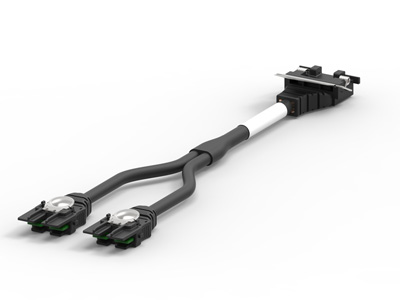
 TE Connectivity (TE) today announced that its microQSFP pluggable connectors, cages and cable assemblies are gaining rapid traction in the industry as indicated by cloud server application design wins and significant ongoing data center switches, and wireless networking equipment design efforts.
The microQSFP is the next-generation input/output (I/O) connector system that enables one-,two- and four-channel pluggable solutions with all the functionality of QSFP28/56 in the same faceplate density as SFP (a single channel solution). One significant milestone to note is the adoption of the microQSFP form factor into the IEEE P802.3cd draft specification, which aims to publish an industry standard defining 50 Gbps, 100 Gbps and 200 Gbps electrical interfaces based on 50 Gbps electrical channels. The most recent industry milestone is the Multi-Source Agreement’s (MSA’s) group’s publication of revision 2.5 of the microQSFP specification, which defines the interoperable methodology for one-, two- and four-channel applications.
The microQSFP form factor is ideal for switches supporting cloud-based and enterprise data centers, server network interface cards (NICs), PCI switching, storage and wireless applications. It supports connections based on both copper and optical media, provides high density, delivers excellent signal integrity (with a road map to 100 Gbps per lane), and enables industry-leading thermal management capacity (up to 7 W). The microQSFP supports a broad application base and offers a low cost and a competitively thermal-efficient form factor for the market.
Brad Booth, principal network architect on Microsoft’s Azure Infrastructure team, said: “microQSFP technology brings compelling features and benefits to next generational data center needs. With the next generation of switch ASICs, microQSFP supports the increased faceplate density in a traditional 1RU pizza box switch. The new architectures must simultaneously address density requirements of switches along with thermal and electrical performance in both switch and server equipment. microQSFP’s ability to address single-, dual- and quad-channel electrical interfaces is well aligned with those needs.”
“Arista is closely attuned to our customers’ needs, and the microQSFP form factor brings many of the right performance levels to address the electrical channel requirements, thermal management, and port densities that our customers need,” said Christophe Metivier, vice president, Manufacturing and Optics at Arista. “As the industry prepares to transition from 25G electrical channels to 50G electrical channels, microQSFP provides an ideal platform to support both data rates while providing the flexibility of one, two or four channels per module.”
Due to it’s thermal performance and low cost, microQSFP is an ideal form factor to support all types of optics; from short reach connections within a datacenter to long reach connections connecting data centers and broader area networks. “The microQSFP form factor provides a good platform for AOI’s optics with excellent signal integrity in both SMT and stacked connectors that also provides an easy-to-implement thermal solution,” said AOI’s Chan Chih (David) Chen, AVP of Sales & Marketing. “Our customers are looking for higher density and the flexibility to take optics all the way to the server NIC as well as the switching equipment. microQSFP provides the right combination of features to enable us to do that.”
Lucas Benson, microQSFP product manager at TE Connectivity, added, “microQSFP is an outstanding solution for a range of networking devices as the industry moves to 25, 50, and 100Gbps and beyond. As the industry looks forward to higher speeds, especially high-density 100G (2x50G), we expect microQSFP to continue and even accelerate its momentum.”
High-volume, production-tooled product is available in SMT (1xN configurations) and stacked press-fit (2xN configurations) versions directly from TE and its various distributors. Direct-attach copper cables with microQSFP plugs are also available directly through TE in both straight and breakout configurations, with transition cables to both QSFP and SFP form factors.
TE Connectivity
www.TE.com

Leave a Reply
You must be logged in to post a comment.