
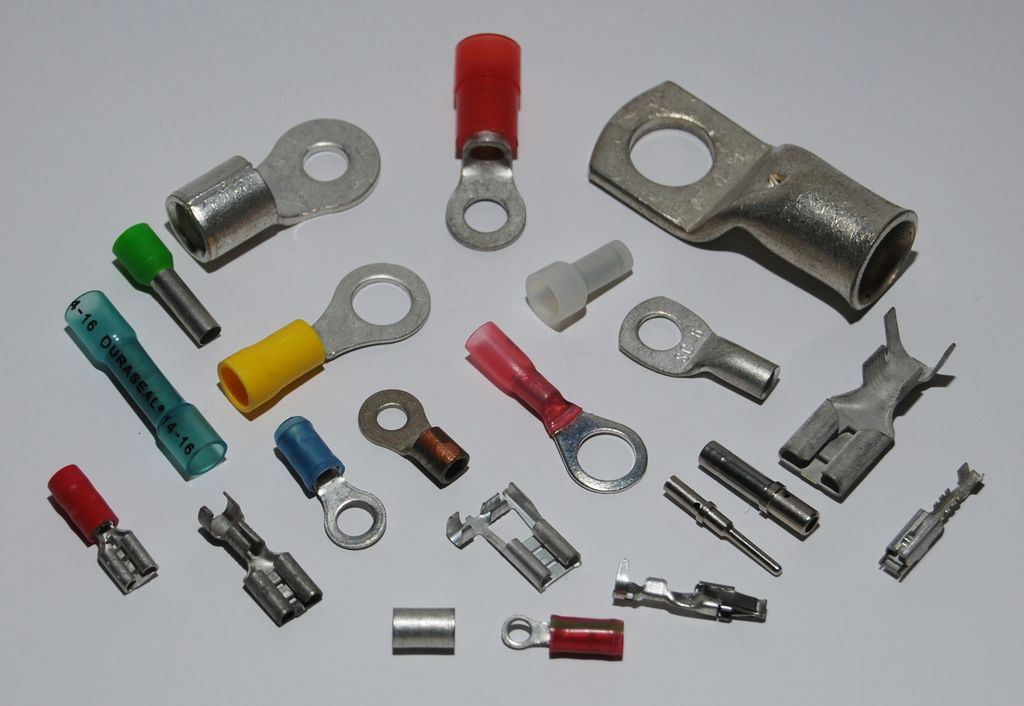
A crimp connector is a type of solderless electrical connector used for terminating stranded wire. Depending on the type, crimp connectors, sometimes called crimp terminals, can be terminated to different configurations of spade-foot connectors, wire splices and screw terminals.
The first step in affixing a crimp connector is to use a wire stripper to remove the electrical insulation from the end of the stranded wire. It is common to see ¾ in. as a general guideline for how much wire to strip, as this is fairly standard for residential electrical wiring. However, the length of insulation that needs to be removed is truly application specific and should be cross-referenced with manufacturer guidelines, especially in industrial use.
Once the insulation is removed, the exposed wire is inserted into the connector. The crimp fitting is then compressed (crimped) around the wire with a pair of crimping pliers. When done correctly, this connection is both mechanically sound and gas-tight.
There are many different types of crimp connectors but the most common are barrel and open barrel. With barrel type connectors the stranded wire is inserted into the cylindrical metal opening (hence, “barrel”) and then crimped. This is perhaps the most commonly seen type of connector.
Open barrel connectors are also aptly named as the “barrel” is spread open into a V or a U shape. A wire is cradled into the connector before it is then crimped close. Since the wire can be laid into the connector as opposed to being threaded into it as with barrel connectors, this type of connector is easier to use in automated applications. These connections are generally stronger than those created by barrel connectors. The strength and ease of use make them common for automotive and industrial uses.
There is much debate over the advantage and disadvantages between crimped and soldered connections. Which connection makes the most sense depends heavily on the specific size and type of wire as well as the application.

Wrong. You should never use crimp cooctnenrs almost all wiring in a high quality audio system. Use only a high quality silver solder on all connections (especially speaker drivers) The sound quality will be better and and wire more secure..
I hate to burst your 3-year-old bubble, but this is about general wiring. Imagine solder splicing every wire, sensor, and computer together in a car. Repairing or removing a component would be a nightmare.
BTW, I use silver plated crimp connectors on my audio equipment. Nobody knows, because there is absolutely no difference in audio quality, even on a measured level. And silver solder is only really required when you’re soldering silver components. Use lead, otherwise. It holds up better than non-lead solders in high vibration environments.
Silver plated crimps….come on…they’d oxidize and you’d have tons of measurable resistance, and quality of sound (both by oscilloscope and by ear). In audio we crimp and solder where appropriate, and as to silver, there’s a reason why some of the best audio solder by Cardas only has ~ 4% silver. Gold is the standard yo plate wit and platinum is the top of the pyramid. They are resilient interactive and don’t oxidize. There’s a reason even on my best gold plated crimps I use a dremel or a diamond file to remove the gold off the copper crimp before crimping it…but I’ll let you speculate as ty o why.
In a car or boat, etc. As much crimping. Will be done as possible as soldered joints fail when flexed repeatedly even by the tiniest of vibrations. The components on circuit boards and panels of course will be componen soldered but by the tone of this conversationeither sound overly audio educated experts. A crimp done properly will cold weld the metal. Strand to strand and strand to connector making 1 solid piece and preserving the sine waves integrity. There’s a reason ABYC E-11, UL486A, DIN 41611, MIL-T 7928, and of course NASA STD 8739-4 specs all exist for crimp stregnth minimums. Ex: a crimp onto 12 gauge spec wire for MIL-T 7928 must hold at least 110lbs before coming off but by UL486A only has to hold 70 lbs before giving way…both quite strong when crimped correct. Go educate yourselves. A great read is https://marinehowto.com/marine-wire-termination/ he really knows his stuff and has laid it all out neat an concise for you. Good luck in your audio endeavours.
And then you stop. As the one discussion showed, there’s a lot more to it. Wire weight and induction loss, breakage points (from ropeworking, 1.5 diameters upstream from where the stiffness changes in the crimp: it’s where stress from flexing (tension on the outside of the bend, compression on the inside) reflects from the change plane to form a local high-stress point greatly increasing the risk of breakage), the actual choice of crimps, etc etc.